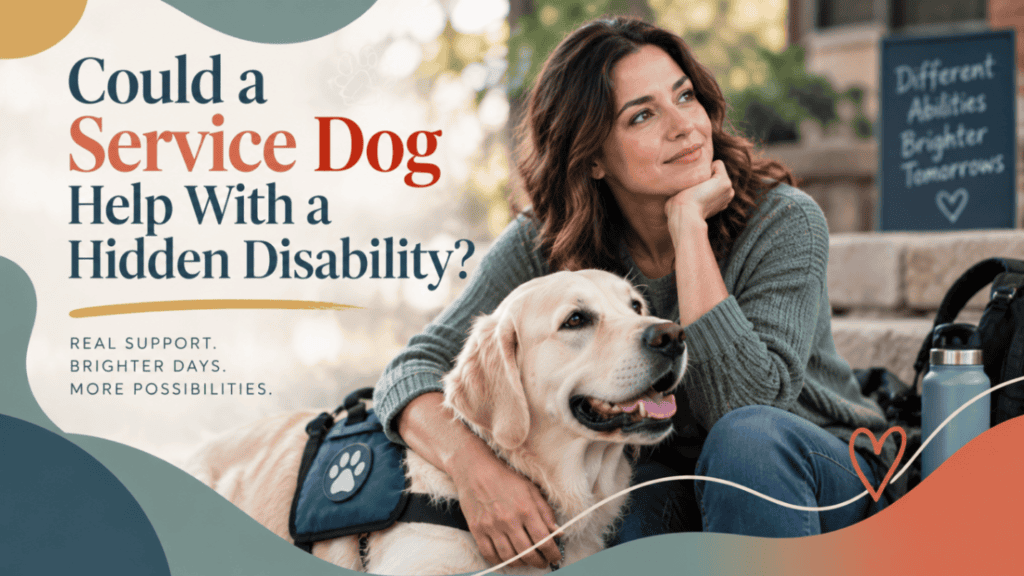
You see a dog in a vest.
You see calm behavior.
Or maybe you see someone walking through a store, sitting in a restaurant, or traveling through an airport with a steady canine partner.
But you may not see the reason the dog is there.
You may not see the warning before a medical episode.
The interruption of a harmful behavior.
The help finding safety during sensory overload.
The quiet support that makes an ordinary day possible.
That’s the gap between what you see and the reality.
For someone with a hidden disability, a service dog may offer more than companionship. A trained service dog may help create:
Freedom
Independence
Safety
Visibility
But a service dog isn’t the right tool for everyone, and no two journeys look exactly alike.
Let’s take a closer look.
Under the Americans with Disabilities Act (ADA), a service dog is a dog individually trained to perform work or tasks directly related to a person’s disability.
That definition matters.
A service dog isn’t simply a well-behaved pet.
A service dog isn’t working because people enjoy having the dog nearby.
The dog is trained to take a specific action that helps the handler manage a disability-related need.
Those tasks might include:
The task may be obvious to the handler.
It may be almost invisible to everyone else.
That’s the point.
A service dog often works quietly in the background, helping a person participate more safely and confidently in daily life.
The work may be invisible. The difference is real.
Yes, a service dog may help someone living with a hidden disability.
Hidden disabilities are conditions that aren’t immediately obvious to other people but still affect daily life in meaningful ways.
They may include:
Someone may look fine while carefully managing pain, fatigue, confusion, fear, or risk.
What you see is a person standing in line.
The reality may be someone calculating how long they can remain upright.
What you see is someone eating dinner.
The reality may be someone wondering whether the food is safe.
What you see is a person entering a crowded room.
The reality may be someone preparing for sensory overload or a panic response.
A service dog can’t erase the disability.
But a trained task can help reduce a barrier.
That can change what becomes possible.
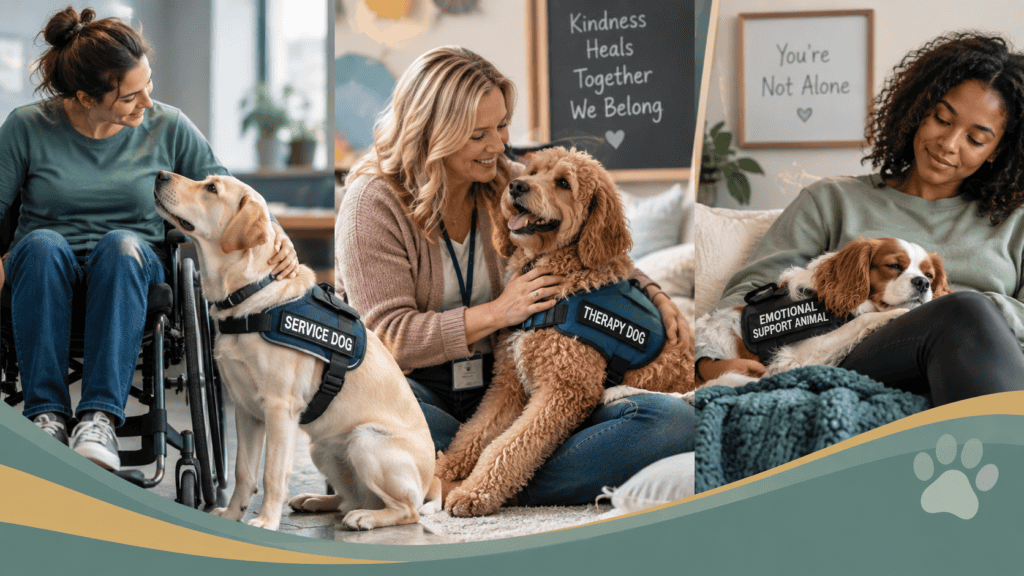
These terms often get used interchangeably.
They aren’t the same.
A service dog is trained to perform specific tasks for one person with a disability.
The dog’s work must relate directly to that person’s disability.
Under the ADA, service dogs generally have access to public places where the public is allowed.
A therapy dog visits other people.
You may see therapy dogs in hospitals, schools, libraries, disaster response settings, or community programs.
Their role is to offer comfort and connection.
Therapy dogs usually enter places by invitation or through an organization’s arrangements. They don’t have the same public access rights as service dogs under the ADA.
An emotional support animal provides comfort through its presence.
That support can be important and meaningful.
However, an emotional support animal usually isn’t trained to perform disability-related tasks, so it doesn’t have the same general public access rights as a service dog under the ADA.
A dog that helps someone feel calmer may be an emotional support animal.
A dog trained to recognize an approaching psychiatric episode and take a specific action to lessen its impact may be a psychiatric service dog.
The difference is task training.
Not the size of the dog.
Not the breed.
And not whether the disability is visible.
Comfort matters. Task-trained support has a different role.
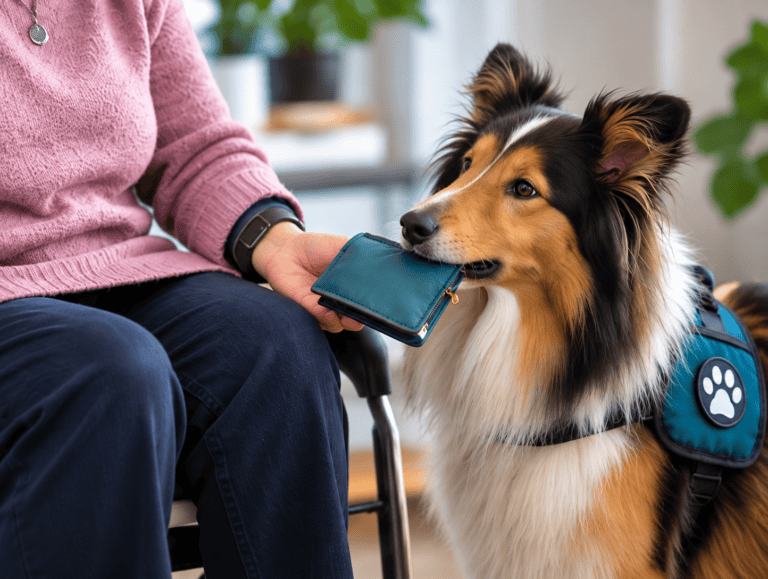
Some service dog tasks happen so quickly or naturally that other people may never notice them.
A psychiatric service dog might:
A medical alert or response dog might:
A service dog supporting autism or sensory disabilities might:
A mobility service dog might:
The right task depends on the person.
It depends on the disability.
It depends on the dog’s abilities, health, temperament, and training.
A service dog shouldn’t be expected to perform every task for every person.
Good support starts with a clear understanding of the actual need.
This question gets asked far too often.
Sometimes it’s spoken out loud.
Sometimes it appears as a stare, a comment, or a challenge at the door.
“You don’t look disabled.”
That sentence may sound like an observation.
For the person hearing it, it can feel like dismissal.
A hidden disability doesn’t become less real because other people can’t see it.
A service dog may help someone:
What you see is a person moving through the community.
The reality may be a carefully supported act of independence.
That dog may help the person stay safe, stay regulated, communicate a need, or respond to an emergency.
The dog may be the reason the person can participate at all.
At Access Unleashed, Barley’s journey helps tell this story.
Barley is being trained as a gluten-detection service dog. She is still in training, and her work supports a hidden disability need that may not be obvious to anyone watching from the outside.
You might see a Labrador.
A friendly face.
A wagging tail.
The reality includes something much bigger.
Barley is learning to detect gluten and alert her handler before exposure. That kind of support can help reduce uncertainty around meals and everyday environments.
It can help turn:
Uncertainty → clarity
Constant checking → greater confidence
Risk → another layer of safety
Barley is still learning and growing.
Her journey reminds us that service dog work is a process. It takes time, patience, consistency, and care.
It also reminds us that a dog can become part of a much larger mission: helping people understand that hidden disabilities deserve visible support.
→ Meet Barley and explore her service dog journey
One dog can open a conversation that helps an entire community see differently.
A service dog can bring meaningful support.
A service dog also brings responsibility.
Before moving forward, consider these questions:
A service dog isn’t a quick fix.
It doesn’t guarantee every environment will become easy.
It isn’t a replacement for medical care, therapy, medication, accommodations, or a trusted support network.
And it may be one part of a larger access plan.
For some people, that part can be life-changing.
In the United States, the ADA provides public access protections for service dogs that meet the legal definition.
The ADA doesn’t require a service dog to wear a vest, patch, or special harness.
It also doesn’t require certification or registration documents for public access.
When the dog’s role isn’t obvious, staff may ask only two questions: