Service dogs matter because you don’t always see the struggle.
Hidden disabilities don’t announce themselves.
There’s no obvious sign. No clear explanation.
And yet—millions of people navigate daily life with challenges most never notice.
Hidden disabilities affect a significant portion of the population—and the need for real, practical support is growing.
That’s where service dogs come in.
If you’re new to this. You can learn more:
Helpful next steps:
→ What Is a Service Dog?
→ What a Service Dog Actually Does
→ What is a Hidden Disability?
Because understanding those pieces changes how you see everything that comes next.
Here’s the reality:
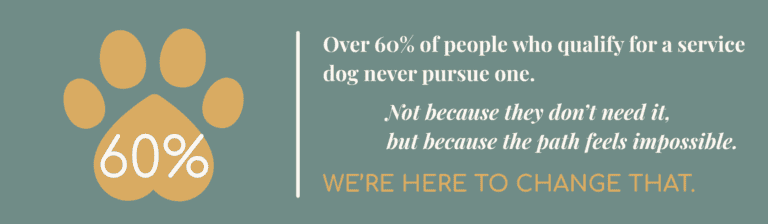
Most people who qualify for a service dog never get one.
Over 60% don’t pursue it at all—not because they don’t need it, but because the barriers feel too high.
Cost.
Training.
Time.
Uncertainty.
For many, it feels out of reach before it even begins.
A mother once shared:
“Our dog became his lifeline… he felt seen and included for the first time.”
That’s what a service dog does.
Not just tasks.
Not just alerts.
Connection. Confidence. Freedom.
For me, this journey started with something small:
A crumb.
Living with Celiac disease means even trace gluten can cause serious harm.
A service dog—like Barley—changes that.
She becomes:
Safety
Confidence
The ability to live without constant fear
But this story was never meant to stop with me.
Because right now:
Service dogs represent something bigger than help.
They represent freedom.
For many, the support they need is real, even when it isn’t obvious to others. Service dogs help bridge that gap, but too many people are left without access due to cost, awareness, and support.
This is exactly why Access Unleashed exists: to make support, resources, and opportunities more visible, possible, and accessible for people living with hidden disabilities.
Behind every service dog is a story.
And right now, that story depends on people who are willing to step in and help.
Help fund freedom—one dog, one story, one life at a time.
Service dogs provide support that is not always visible but can significantly impact safety, independence, and daily functioning.
The cost, training time, and access to resources can make it difficult for many people to pursue a service dog.
No. Service dogs can support people with a wide range of needs, including medical, neurological, and psychiatric conditions.
Stay connected to Barley’s story and what comes next.
Be part of bringing independence home—one step at a time.
Help turn stories like this into real, life-changing support.